
HER is one of the few big apps that tries to do both: give you people to date and a community to be part of. That sounds ideal,until you actually start using it and realize it doesn’t behave the way most dating apps do. It isn’t swipe-first, and that catches a lot of people off guard. If you go in expecting something like Tinder or Hinge, you can burn through a lot of energy without much momentum. This review answers one question: is HER better for dating, or for community, what does that mean for your time?
See where HER fits in our ranked guide to the best dating apps in 2026.
Quick Verdict: HER is community-first, and that changes everything
HER works best if you want queer community alongside dating and don’t mind slower, indirect momentum. It works poorly if your goal is fast, date-first throughput and you’re not interested in “hanging out” inside an app to get there.
Think of HER as vibe over volume: more context, more social signal, and fewer clean handoffs to dates.
Best for:
- You want to meet people through shared context (feed posts, events, mutuals), not just swipe-and-go
- You live somewhere with a strong queer presence, where the feed actually feels active
- You’re willing to trade speed for signal and read vibe before investing
Not for:
- You want an efficient swipe-to-date pipeline
- You’re in a smaller city where the feed dries up quickly
- You prefer quiet, low-visibility swiping and don’t want to post or engage publicly
Why this matters if your time and energy are limited
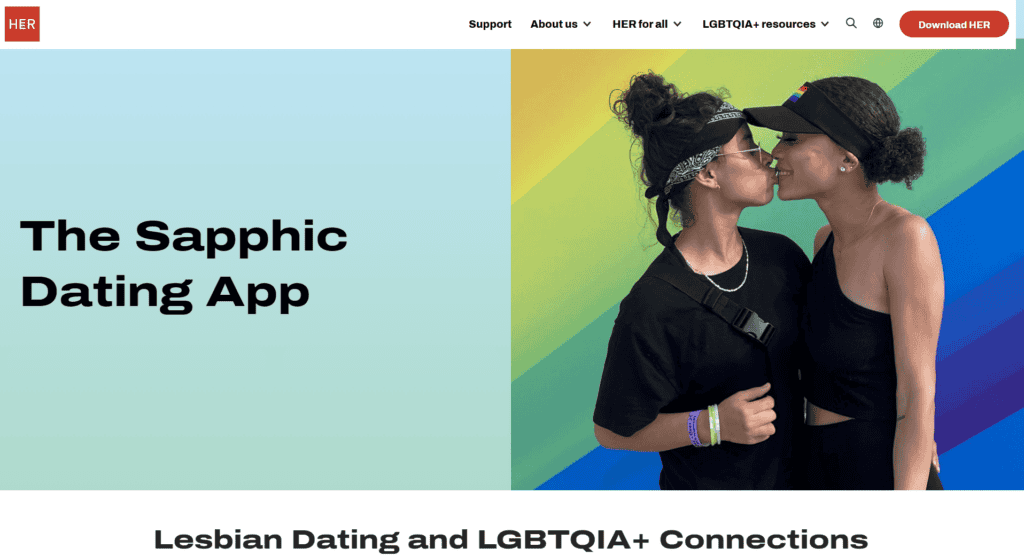
HER positions itself publicly as a sapphic dating app, but its internal structure emphasizes community and shared spaces over fast matching.
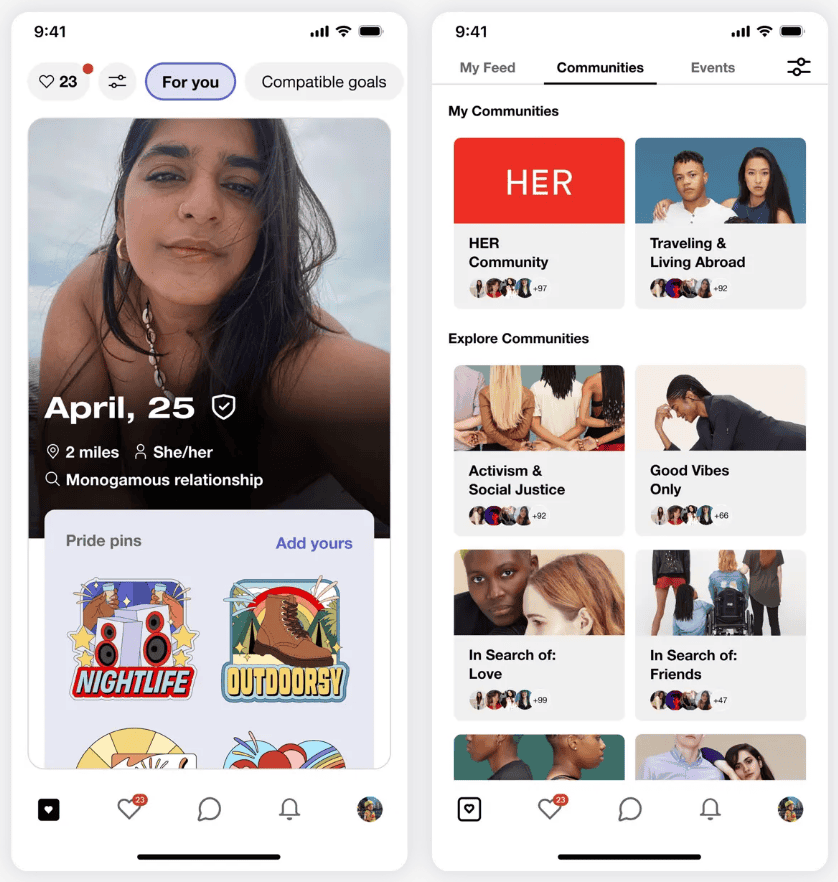
HER can feel busy even when nothing is really happening. You’re not just swiping, you’re browsing, reading posts, noticing who shows up, and deciding whether it’s worth engaging. For some people, that feels like friction. For others, it’s useful context.
The real cost is wasted energy from intent mismatch. A common trap is thinking, “If I just use it more, it’ll start working like Tinder.” It won’t. Using HER more often usually leads to more community interaction, not automatically more dating momentum. You can’t force it into becoming a dating conveyor belt if the local culture leans community-first.
If you’re interested in this topic, we’ve put together a detailed HER vs Tinder comparison to break down which app works better for women dating women.
What HER is genuinely good at
HER’s strongest upside is early filtering through social context. The feed gives you more signal than a static profile ever could. You can often tell faster whether someone is actually present, engaged, and socially real or just technically available.
It also makes connection feel less transactional. If you’ve ever opened a dating app, scrolled through strangers for ten minutes, and closed it feeling flat, HER can feel warmer. There’s culture. There’s tone. That doesn’t guarantee dates, but it does change how the app feels to use.
From a safety and consistency standpoint, the public layer helps too. Not because it proves anything, but because it creates more surface area. When someone’s story, presence, or behavior doesn’t line up, it tends to show over time.
Where HER fails (and why it frustrates dating-first users)
The same community layer that adds context can dilute dating focus. If you want a clean path to “let’s meet,” the feed can feel like noise or extra steps before anything concrete happens.
Location matters a lot. In larger cities, new faces and energy tend to cycle in regularly. In smaller ones, stagnation hits fast. It often shows up as opening the app on your lunch break and seeing the same three posts again, because the local feed hasn’t refreshed since yesterday.
There’s also a visibility trade-off. HER isn’t just about matching; it’s about being seen. Community posts and location-aware discovery make your presence more public than on swipe-only apps. If you value privacy, that can feel like too much. You have to be intentional about what you share, how identifiable you are, and how “out there” you want to be.
HER for different intents (casual, serious, and community-first)
Casual dating:
Works when you’re comfortable meeting people through the social layer and don’t mind extra steps. Fails when you want fast, low-effort swiping that leads directly to dates.
Serious dating:
Works when you want alignment and context before investing in deeper conversation. Fails in low-activity areas or when most users are there primarily for community rather than relationships.
Community-first connection:
Works well if your main goal is queer events, shared culture, and social presence, with dating as a possible bonus. Fails if you assume a queer-focused app automatically produces stronger dating outcomes everywhere.
Is HER worth paying for (Gold/Premium vs Platinum)?
You shouldn’t pay expecting better results. You pay for less friction.
The free tier is usable. You still get access to the feed, the overall vibe, and the ability to connect. Paid tiers mainly change convenience: how much you can browse, how visible you are, and how constrained the experience feels.
- Free — Limited swipes, full access to the community feed, basic matching
- Premium / Gold — Higher swipe limits and more filters, but still capped for heavy use
- Platinum — Unlimited swipes, maximum visibility, and the fewest constraints
- Heavy daily use — Unlimited swiping is increasingly Platinum-only
Pricing varies by region. In the U.S., Premium often sits around $14.99/month and Platinum around $31.99/month. EU pricing is usually lower on longer plans.
HER is rated 18+ on the App Store. This review assumes adult use.
HER vs alternatives (when you should choose something else)
Lex:
Better if you want community-first connection without a hybrid feed-and-dating structure. It’s simpler and more expression-driven, with less ambient noise.
Taimi:
Better if you want a larger LGBTQ+ pool and don’t mind a louder, more feature-heavy environment. Sometimes more active than HER, sometimes just more cluttered.
Hinge:
Better if you want date-first momentum. Clear match-to-date pacing, minimal community layer, and less ambiguity about intent.
Common myths people bring to HER
“If I just use it more, it’ll start working like Tinder.”
More usage usually means more feed interaction, not more dates.
“Paying means I’ll be seen by the right people.”
Paying smooths the experience. It doesn’t change who’s actually there.
“Because it’s queer-focused, people must be more serious.”
Queer focus shapes the vibe, not intent. That varies by location and local culture.
When to quit or switch instead of grinding harder
Quit or switch if you’re mostly scrolling and nothing is clicking.
Quit or switch if you want a quieter, more private dating experience and feel overexposed.
Quit or switch if you’re considering paying mainly to “make it work.” That’s usually a bad signal.
In those cases, a different app or a different environment will do more than upgrading ever will.
Final takeaway
HER is worth using if you want queer community with the possibility of dating and you’re okay with slower pacing in exchange for context. It’s a poor fit if you want speed, efficiency, and a tight match-to-date pipeline.
One-line fit reminder: Community-first users tend to feel at home on HER. Dating-first users often feel stuck waiting.