Yes, Facebook Dating is worth trying in 2026, and it won’t cost you a dollar to find out.
Nobody talks about Facebook Dating at the bar. Nobody posts screenshots of it. Nobody complains about it the way they complain about Tinder or Hinge. It just kind of exists inside an app you already have, doing its thing while everyone argues about which $35/month subscription is the least disappointing.
And that weird invisibility is exactly why I wanted to review it, because a free dating app with 21.5 million daily users that nobody seems to have an opinion about is either quietly working or quietly failing, and I wanted to find out which one.
Facebook Dating launched in the U.S. in September 2019 and isn’t a standalone app. It lives inside the Facebook app, next to Marketplace and Groups. You create a separate dating profile that Meta says won’t appear on your News Feed or be visible to friends (Meta Newsroom).
To use it, you need to be 18+, have a Facebook account in good standing that’s at least 30 days old, and live in one of the 52 countries where it’s available (Facebook Help Center).
How this review works This Facebook Dating review looks at what actually happens when you use the app: what you get for free that other apps charge for, where the experience falls short, and whether the people on it near you make it worth your time. The goal is to help you decide if Facebook Dating fits how you date, not how Meta markets it. For more on our process: How We Review Dating Apps (2026): What Actually Matters
Table of Contents
Facebook Dating: Free, Flawed, and Worth Trying Anyway
Facebook Dating is one of the few mainstream dating apps in 2026 that doesn’t gate core features behind a subscription. You can see who liked you, message before matching, and get matched through shared groups and events, all without spending a dollar.
The trade-off is that the active crowd near you can feel thinner than the big three, the interface is rougher, and you’re handing Meta your dating life on top of everything else it already knows about you.
Facebook Dating looks strong on paper (especially being free), see how it compares to Tinder’s user base and match volume,here: https://trustyourmatch.com/tinder-vs-facebook-dating/
The Cost of “Free”
Most people don’t even consider Facebook Dating. The name alone makes it sound like something your aunt would recommend.
But while you’re spending $30-50/month across Hinge+ and Tinder Gold for the privilege of seeing who liked you, Facebook Dating has been offering that for free since 2019. The real question isn’t whether Facebook Dating is a great app. It’s whether the free access to features you’re currently paying for elsewhere makes it worth adding to your rotation, or even replacing the other apps.
That’s what “is Facebook Dating worth it” really comes down to: not whether it’s better than Hinge, but whether it gives you enough for free that the trade-offs stop mattering.
The stakes are simple: time and privacy.
Time because every app you add is another thing to check, another inbox to manage, another set of conversations that might stall out. Privacy because this is Meta, and the company that already knows your political views, shopping habits, and who you were friends with in high school now also gets to know your dating preferences.
What Facebook Dating Actually Does Well
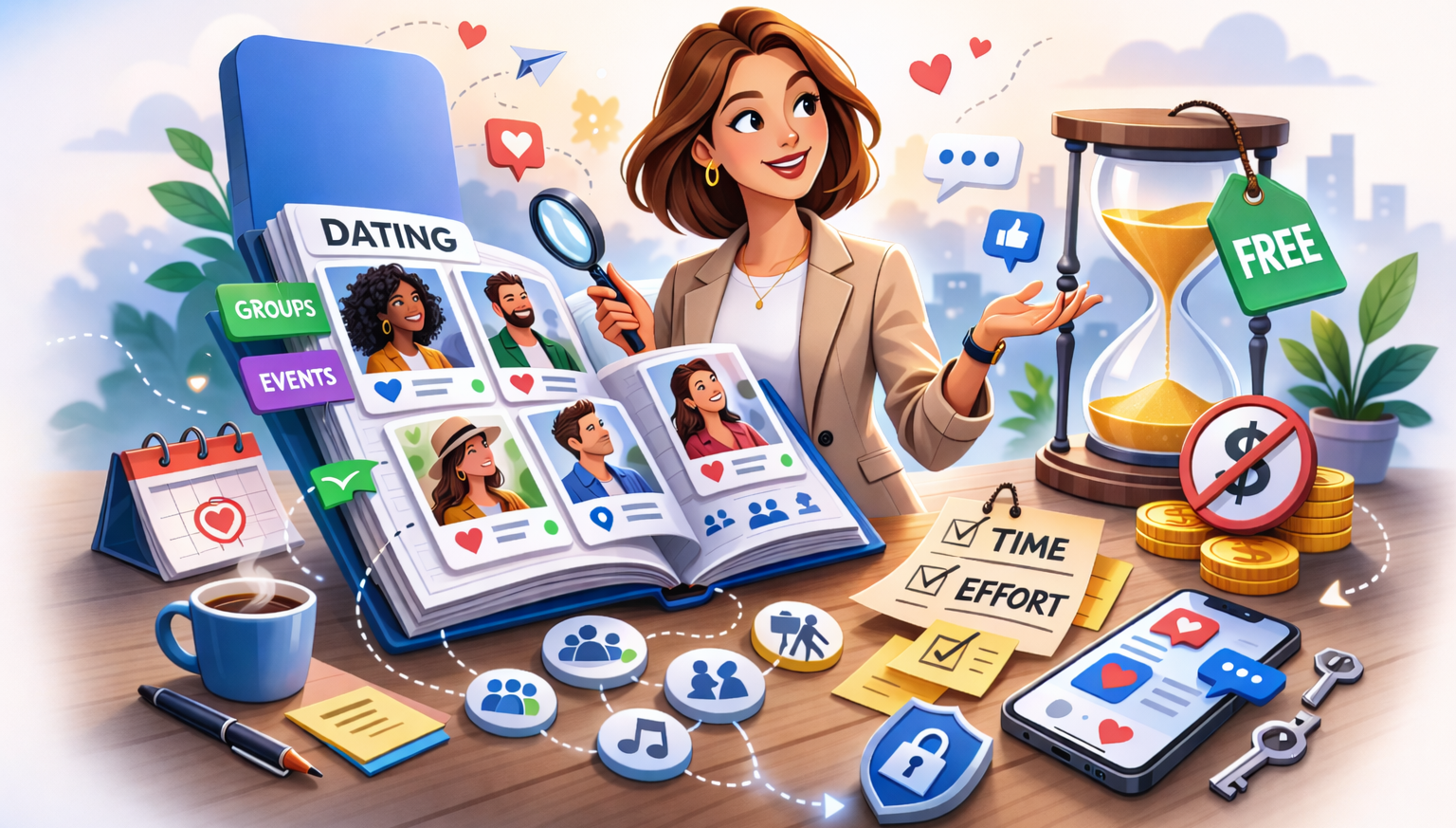
Groups and events matching is the feature that no other app has figured out how to copy. If you’re in the same Facebook group as someone, or you’ve both RSVP’d to the same local event, Facebook Dating can surface that connection.
On Bumble or Hinge, you’re matching based on photos, prompts, and distance. Here, you might match with someone because you’re both in the same hiking group or going to the same concert next weekend. That’s a built-in conversation starter that other apps can’t offer because they don’t have your social data.
Message with your like, for free. On Hinge, free users get a comment with their like, but they’re capped at a limited number of likes per day (often around 8, though it varies). On Tinder, attaching a message to a like is a Platinum feature that runs around $30/month. Facebook Dating lets you do it without limits and without paying.
See who already liked you, completely free. On Tinder, that’s a Gold feature (roughly $25-30/month). On Hinge, free users see incoming likes one at a time. Facebook Dating shows your incoming likes in the Liked You tab without a paywall.
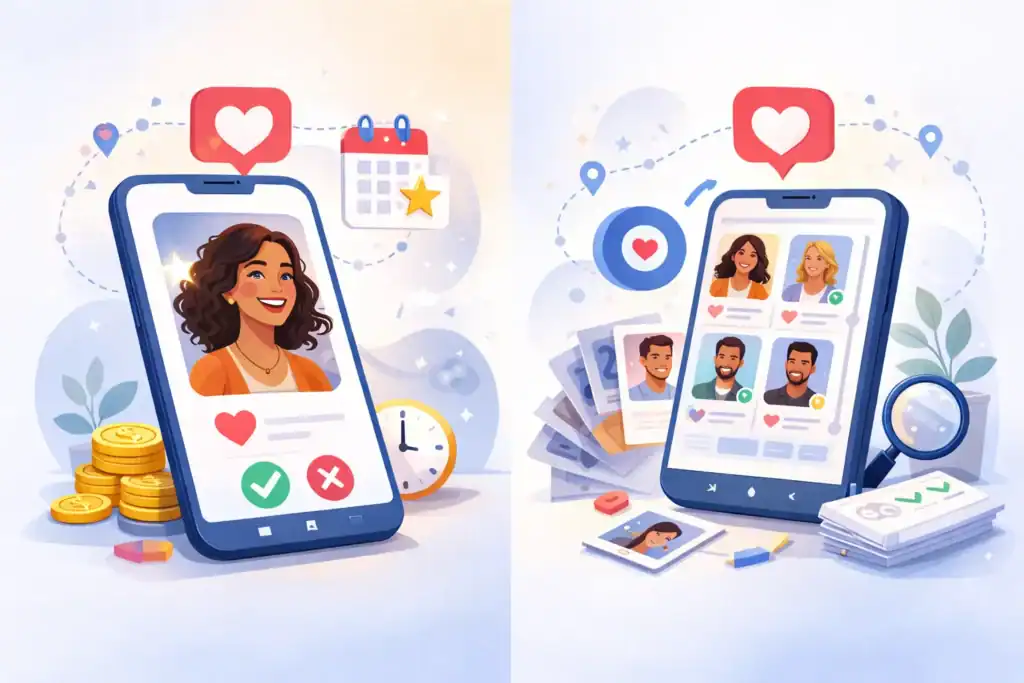
Secret Crush is unique to this app. You pick up to nine Facebook friends or Instagram followers you’re interested in. If they’re on Facebook Dating and add you back, you both get notified. If it’s one-sided, nobody ever knows. It’s a low-risk way to test the waters with someone you already know, and no other app does anything like it.
AI dating assistant + Meet Cute. Meta rolled out an AI dating assistant and a weekly “Meet Cute” surprise match in September 2025. The assistant lets you type natural prompts like “someone who likes hiking and live music” instead of just swiping. The Meet Cute feature sends you one algorithm-picked match per week. Both are free. Bumble and Hinge charge for comparable recommendation tools.
One thing worth watching: the assistant also helps people write their bios and craft opening messages, and you can already feel it. Some conversations in 2026 have that same over-polished tone where both people sound like they were coached by the same chatbot. It’s useful if you’re stuck on what to say, but it does make it harder to tell who sounds like themselves and who’s just forwarding what the AI suggested.
Anti-spam messaging. Once you send someone a message, you can’t send another until they reply. That prevents the pile-on problem that plagues most apps and is something a lot of women have specifically mentioned appreciating.
Where Facebook Dating Falls Short
The biggest issue is activity. Facebook Dating has 21.5 million daily active users across 52 countries (also reported by Global Dating Insights), which sounds impressive until you compare it to Tinder’s 7.3 million in the US alone. The numbers are growing, with 1.77 million US users aged 18-29 and daily conversations in that age group up 24% year over year.
But in practice, matches can take longer to reply, conversations can feel slower, and some profiles look like they haven’t been touched in weeks.
A few specific patterns worth knowing:
- Ghost matches are more common here than on Hinge or Bumble, likely because some users activated Facebook Dating out of curiosity and never came back
- Profile quality is inconsistent, since the app auto-fills from your Facebook profile, a lot of people don’t bother customizing their dating profile beyond the bare minimum
- Fake profiles and scam accounts are a real issue. Meta has age verification through Yoti and selfie verification, but the lack of any paywall means there’s no financial barrier filtering out low-effort or fraudulent accounts
- Distance accuracy can be weirdly off. WIRED reported that multiple users complained about being shown profiles far outside their area, with one user saying “no one is ever near me, which is interesting given there are so many users.” Several users noted the algorithm improved over time, but that first impression can make you question the whole app
The interface feels like what it is: a feature tucked inside Facebook, not a purpose-built dating app. It works fine, but it doesn’t have the polish of Hinge’s prompt-based profiles or Bumble’s design. Switching between your regular Facebook feed, Marketplace, and your dating profile all within the same app creates a weird context collision that dedicated apps avoid entirely.
Facebook Dating for Casual Dating, Serious Relationships, and Everything Between
Casual dating: Works when you want to meet people with zero financial commitment and you’re fine with a slower pace. The groups and events matching can lead to natural, low-pressure connections because you already have something in common. Fails when you want fast, high-volume matching with a large, constantly active crowd. Tinder still dominates that space by sheer numbers.
Serious relationships: Works when you’re patient and willing to wade through some low-effort profiles to find people who actually wrote a bio and put thought into their answers. The user base skews slightly older (core demographic is 30-40+), which can mean more people looking for something more long term. Fails when you want the structured, prompt-driven profiles that apps like Hinge use to help conversations get past small talk.
Testing the waters after a break: Works well for this. You don’t need to download anything, you don’t need to create a new account from scratch, and you’re not committing money before you know if you’re even ready to date again. The On Pause feature also lets you take breaks without deleting your profile. Fails when you need a confidence boost from active engagement, because slower response times can feel discouraging if you’re already unsure.
What Does “Free” Actually Cost You?
Facebook Dating has no paid tiers and no premium subscription. Everything is free.
In 2026, when Hinge+ costs around $30/month and HingeX runs $50/month, and Tinder Gold sits around $25-30/month, a fully usable free experience is a genuinely meaningful differentiator.
But the reason it’s free is straightforward: Meta doesn’t need your subscription money because it’s already making money from your data. Your dating preferences, who you like, who you reject, what groups you’re in, what events you attend, all of that feeds into Meta’s advertising infrastructure.
Facebook Dating activity supposedly isn’t used for targeted ads on the main app, but this is the same company that has faced multiple data privacy scandals over the years. You believe that as much as you trust Meta in general.
If your problem is spending too much money on dating apps that aren’t delivering results, Facebook Dating solves that immediately.
If your problem is privacy, and you’re uncomfortable with how much data Meta already has on you, adding your dating life to the pile makes it worse, not better.
There’s also a hidden cost to free: no quality filter. On paid apps, the paywall itself acts as a loose filter. Someone who pays $30/month for Hinge is at least somewhat invested. On Facebook Dating, the barrier to entry is having a Facebook account, which is about as low as it gets. That’s why the ratio of serious users to casual browsers to inactive profiles to scam accounts feels less curated than on apps where people are paying to be there.
How Facebook Dating Compares to the Alternatives
Hinge is the better app if you want higher-quality profiles and a more intentional matching experience. The prompt-based profiles force people to show some personality, and the “Designed to Be Deleted” philosophy attracts people who say they want something serious. But Hinge’s free tier has gotten more restrictive (8 likes per day, one incoming like visible at a time), and getting the full experience runs $30-50/month. If Hinge is working for you and money isn’t an issue, stay there. If you’re frustrated with the limits of free Hinge, Facebook Dating gives you many of the same paid features at no cost.
Tinder has the biggest user base by far, which means the most options. But Tinder in 2026 is increasingly pay-to-play. Free users face like limits, can’t see who liked them, and get buried behind paid profiles using boosts and priority likes. If your problem is volume and you don’t mind paying, Tinder is still unmatched. If you’re tired of paying for visibility on Tinder and getting inconsistent results, Facebook Dating’s level playing field might feel refreshing.
Bumble has the women-first messaging model, which some people love and some people find frustrating because of the 24-hour timer. Plenty of Fish is another free option, but it has a much worse reputation for profile quality and spam. Between the two free options, Facebook Dating is the better product.
Myths About Facebook Dating That Keep People Away
“It’s just for old people.” The core demographic skews 30-40+, but Meta reported 1.77 million US users aged 18-29 and that number is growing 24% year over year. It’s not Tinder’s crowd, but it’s not a retirement community either.
“Your Facebook friends will see your dating profile.” They won’t. Facebook Dating uses a separate profile that’s only visible to other people using the dating feature. Your friends, family, and coworkers on regular Facebook can’t see it unless they’re also on Facebook Dating and meet your match criteria. The Secret Crush feature is the only exception, and that requires both people to opt in.
“It’s full of scams and fake profiles.” There are some, just like on every dating app. About 52% of online daters say they’ve encountered someone they thought was trying to scam them, and that’s across all platforms, not just Facebook. Meta has added selfie verification, age verification through Yoti, and you can share your live location with a friend through Messenger when meeting someone. Use video calls to verify people are real before meeting in person, the same way you would on any app.
“Free means bad.” Free means Meta makes money from you differently than Hinge does. The features themselves, seeing likes, messaging, matching through groups, are genuinely on par with what paid apps offer. The experience varies based on who’s using it in your area, not because the product itself is broken.
When to Stop Using Facebook Dating
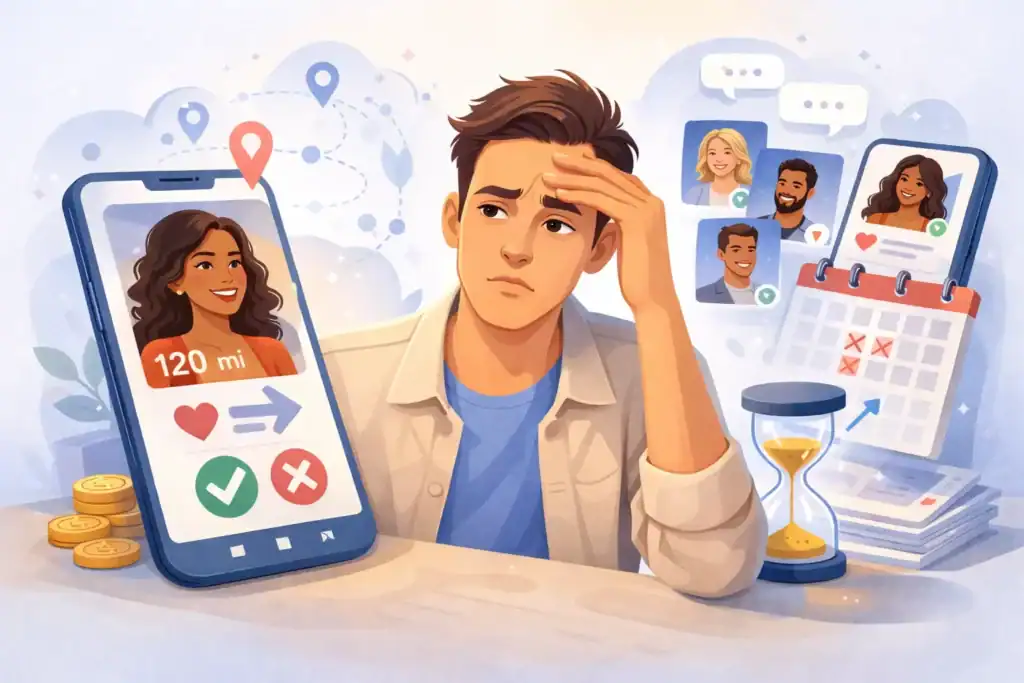
No matches after 3-4 weeks? If you’re getting nothing at all, or every match either doesn’t reply or turns out to be a fake profile, the app doesn’t have enough active users near you to be worth your time. Switch to something with a bigger local presence.
Privacy weighing on you? Listen to that. Dating apps already drain a lot of people, and knowing that Meta is connecting your dating behavior to your entire social graph can make it worse. If that thought makes you uncomfortable enough to second-guess your swiping, the app is costing you something even though it’s free.
Swiping out of boredom? If you find yourself checking Facebook Dating because it’s right there in the same app you use for everything else, that’s a sign to delete the dating profile and come back when you actually want to use it. The ease of access that makes it convenient to try also makes it easy to waste time on passively.
The Final Word on Facebook Dating in 2026
Facebook Dating is the strongest free dating option available right now. It gives you features that cost $30-50/month on competing apps, it matches you through shared interests and social connections in ways no other app can, and it keeps getting better with the new AI tools Meta is rolling out.
The trade-offs are real: smaller user base, more inconsistent profile quality, less polished design, and the ever-present question of how much you trust Meta with your personal life.
But if you’re already on Facebook and you’re either burnt out on paying for dating apps or just want to add another option to your rotation without spending money, there’s no good reason not to try it. The price is right. The question is whether the people on it near you make it worth your time, and the only way to find out is to spend a few weeks on it and see.
If you’re already happy with what Hinge or Tinder is doing for you, Facebook Dating probably isn’t going to change your life. If you’re frustrated with what you’re getting for $30+/month elsewhere, is Facebook Dating worth it as your next move? Yes, and it won’t cost you anything to find out.