
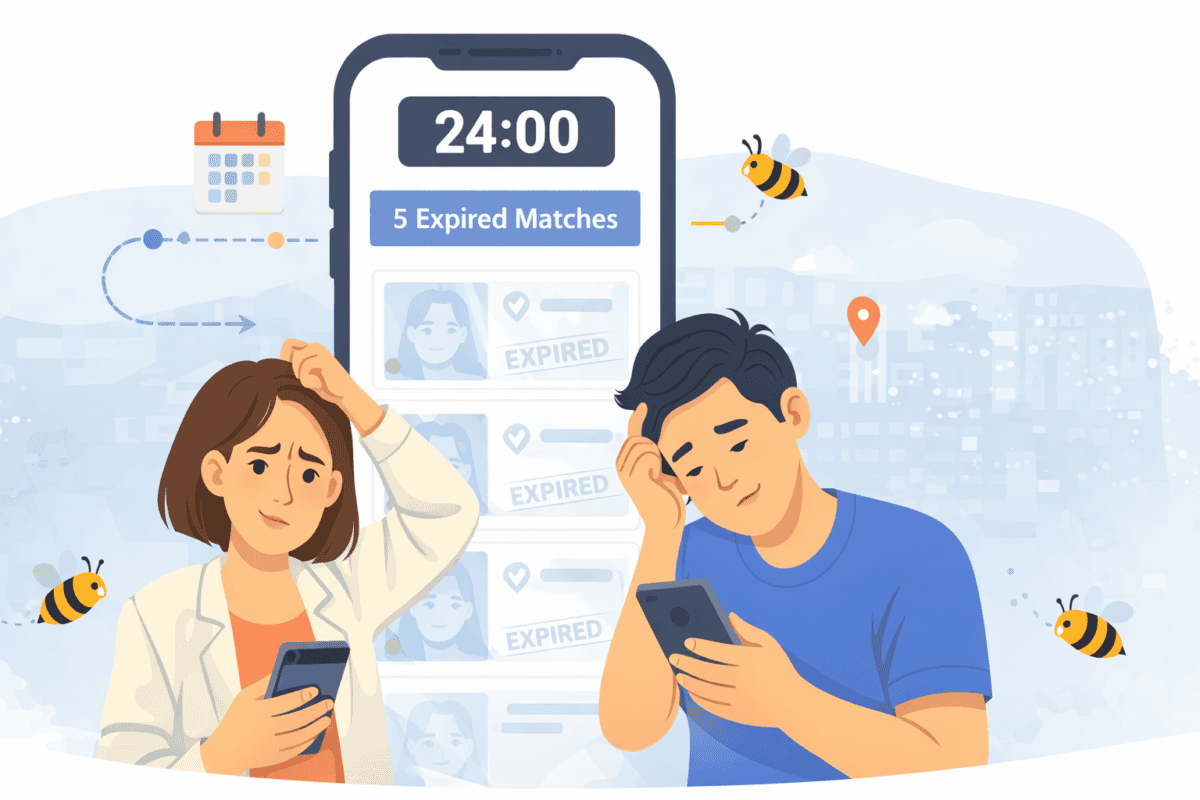
Most people don’t open a Bumble review because they’re curious about features. They open it to answer one question: does Bumble work? Does it turn attention into actual dates? Bumble can work, but only if you’re willing to date at Bumble’s pace, not yours.
While most dating apps are ‘swipe and wait,’ Bumble’s standout feature remains its unique messaging rule: in heterosexual matches, women must send the first message (or respond to an Opening Move) within 24 hours to start the conversation
What Bumble is: a match-first dating app built around a 24-hour start window
What it does: forces fast chat starts using the 24-hour timer and provides prompts (Opening Moves) to lower the barrier for women to initiate
What it does not do: it doesn’t expand your local pool, and it doesn’t remove the need for someone to start the conversation before the timer runs out
This review focuses on outcomes: where Bumble converts, where it stalls, and which dating styles it quietly punishes.
Who Bumble still works for in 2026
This bumble review comes down to one thing: the 24-hour clock. If you want quick momentum and you can keep up with it, Bumble still makes sense. If you date in bursts, or you don’t want your phone to feel like a daily obligation, it’ll feel like you’re constantly “losing progress.”
Bumble still works best for:
- People who open the app most days and like quick starts without weeks of build-up
- Daters in big, active cities where new profiles keep showing up
Bumble is usually a bad fit if:
- You’re a “Sunday Night Swiper” who ignores the app during the work week — Bumble will be a graveyard of expired matches by the time you log back in. It’s basically a tax on your time.
- You’re in a mid-sized or thin pool where it starts feeling like a digital ghost town
- You expect matches to just sit there patiently
Bumble stays on people’s phones because it’s an ecosystem, not just “Date mode.” You can switch into Bumble For Friends (BFF) for platonic connections, and Bumble Bizz for networking. If you’re burnt out on dating, that toggle is genuinely useful. Just don’t assume it’s chill: the “start it before it expires” dynamic still exists, and in Bumble For Friends the window is typically 72 hours, not 24.
How this review works
This review looks at what actually happens when you use the app. How people get seen, how fast things move, and whether conversations turn into dates. The goal is to help you decide if the app fits how you date, not how it’s marketed. For more information on our methods see: How We Review Dating Apps (2026): What Actually Matters
Why Bumble’s timer is the real decision

Most apps punish you with silence. Bumble deletes the attempt.
I’ll be honest: if you have a life that doesn’t involve checking your phone every morning like it’s a job, Bumble is going to frustrate you. Not because the app is “bad,” but because it’s built around speed, and it treats slow pacing as a failure condition.
This is also where the “women message first” slogan stops being useful. In 2026, Bumble is a ruleset that changes depending on who matched with who, and the timer sits underneath all of it.
Bumble messaging rules
Straight matches: women either send the first message or set an Opening Move; if an Opening Move is set, the man can start the conversation by replying to it
Same-gender matches: either person can message first (and either person can use or respond to Opening Moves)
Non-binary matches: either person can message first (and either person can use or respond to Opening Moves)
What expires: a match expires if no one sends a message within 24 hours of matching
Opening Moves: changes who has to type first, but doesn’t remove the 24-hour window
Extend: adds time before the conversation starts; paid tiers allow unlimited Extends
Regional variance note: Bumble has country-specific rule changes, so don’t treat any one setup as universal
And yeah, this hits differently in 2026. In a world where “Luddite Clubs,” offline mixers, and no-phone hangouts are having a moment again, Bumble’s timer can feel like a stressful relic: always-on, always-urgent, always ticking.
Also, a small thing that adds up: the “your match is about to expire” pings can feel less like a helpful reminder and more like a manager nudging you about a deadline.
What Bumble Is good at

Bumble is good at creating momentum for people who actually want momentum.
The timer does one thing well: it prevents your matches from turning into a dusty shelf of “maybe someday.” Either the conversation starts soon, or the attempt disappears. That’s harsh, but it’s also clean.
Opening Moves can reduce the dead-start problem where nobody knows what to say. If an Opening Move is present, the other person can respond to it right away. It changes who has to type first, but it doesn’t change the deadline.
Bumble’s best-case experience is simple: match, start, talk, decide quickly whether it’s going anywhere. If you like that kind of pace, Bumble enforces it.
Safety & verification: Bumble is stricter than some high-volume apps in a few practical ways. There’s Photo Verification, ID Verification (available in some markets), and Private Detector, which can automatically blur suspected explicit images in chat so you decide whether to view or report. None of this makes the app “scam-proof,” but it’s one of the few areas where Bumble’s built-in tooling actually reduces risk.
Where Bumble fails
Bumble fails when your dating life doesn’t match its pacing.
If you’re busy, burnt out, traveling, or you just don’t want daily check-ins, the app starts to feel like upkeep. You come back later and the matches you thought you had are gone. Not “stale.” Gone.
It also fails in a very specific way for straight matches: one side is expected to set the stage quickly, the other side can’t just freestyle a first message unless there’s an Opening Move to respond to, and the timer doesn’t care which one of you had a long day.
The drop-off loop (why it feels like “activity” without dates)
- Match happens → nobody starts within 24 hours → expiration
- Opening Moves gets a reply → still needs follow-up inside the same window
- Thin local pool → repeats show up faster → swiping without progress
If you’ve ever thought, “I’m getting matches but nothing is happening,” Bumble is one of the few apps where that can be literally true.
Bumble for different goals
If you want a relationship: works when you like a clear pace and you want to quickly sort for people who will actually start a conversation inside the window. Breaks down when your local pool is thin or inconsistent, because the timer kills slower starts before they warm up.
If you want casual dating: works when you want fast starts and low ambiguity, especially in busy cities where the queue refreshes constantly. Breaks down when you aren’t checking often, because Bumble doesn’t wait around.
If you’re dating in LGBTQ+ / non-binary spaces: works when you want symmetrical starts (either person can message first) and you like a deadline that keeps things moving. Breaks down when you’re in a smaller niche pool, because attempts burn fast and the app can cycle the same profiles.
Is it worth paying for Bumble in 2026?
Paying on Bumble mostly buys you two things: less guessing and more control over the clock. It does not buy you a bigger local pool, and it does not change whether people follow through once a chat starts.
Here’s the more concrete version, without pretending prices are identical everywhere:
- Bumble Boost: typically $20–$30/month.
- Bumble Premium: typically $30–$45/month.
Exact pricing varies by region and plan length — check in-app for your price.
Note on the Premium+ tier: Bumble also sells a Premium+ level in some markets, and it can climb to around $79.99/month. It’s basically “Premium, plus visibility juice”—things like getting your likes seen sooner, plus extra visibility tools, and in some rollouts access tied to Trending profiles/tabs. For most people it’s overkill, but it’s worth knowing it exists so you don’t feel like you’re missing the “real” version by sticking to the standard tiers.
Bumble also offers a Lifetime payment option (usually around $230–$250) for those who want to avoid the subscription fatigue I mentioned earlier.
What paying changes
- You stop swiping blind because you can see who already liked you
- You can filter harder up front so you don’t build dead-on-arrival matches
- You get more clock control, especially around Extends
If you’re already getting matches but losing them to expiration, paying can feel like buying back wasted attempts. If you’re not getting likes at all, Premium can’t manufacture demand.
If Bumble isn’t your app, what to use instead
Hinge is the better pick if you want slower, more deliberate conversations and you don’t want a countdown attached to every new match.
Tinder is the better pick if you need raw volume. Bumble can feel cleaner in pacing, but the bigger pool often matters more than any timer mechanic.
If you want fewer swipes and a date-scheduling-first model, Breeze is a different approach.
Common myths that waste time on Bumble

“My matches will turn into conversations eventually.” On Bumble, they often won’t, because the match can expire before a first message exists.
“Women message first means women always initiate.” In straight matches, women still control the start, but with Opening Moves it’s less “women always write first” and more “women set the stage first.” The real rule is the ruleset plus the clock.
“Premium fixes Bumble.” Premium changes visibility tools and reduces guessing. It doesn’t change the fact that someone still has to start the chat inside the window, and it doesn’t make people follow through once a chat begins.
When to quit or switch
Quit or switch when the app is reliably turning your time into expirations instead of conversations.
- Your match queue is consistently full of expired connections
- You’re in a mid-sized or thin pool and you keep seeing the same profiles cycle
- Your rhythm is “I check in when I feel like it,” and Bumble keeps deleting attempts before they become conversations
Final takeaway

This bumble review isn’t saying Bumble “doesn’t work.” It’s saying Bumble works for a specific type of dater: someone who wants speed and can maintain the pace. If you don’t want daily maintenance, or your pool is thin enough that expiration becomes the main experience, it’s not worth dragging out.
Already using Bumble and wondering if Premium is worth it? See our Bumble Premium review to decide if paying removes your specific bottleneck.
Bumble is for the “Daily Habit” dater; if you’re a “Weekend Warrior,” Hinge will save you more time (and sanity).