

Stop wasting weeks on ‘good’ chats that go nowhere. If you aren’t moving from chats to dates, you’re just a pen-pal.
The shift from chatting to a first date usually comes down to one thing: making a real plan that’s easy to accept or decline, so you find out fast whether meeting is actually on the table.
Chat can feel like progress because it’s constant.
But meeting is the moment where intent shows up.
Struggling to start the cha? Check out my 15 Genious Tinder openers that actually work
If you keep seeing long chats with no plan, this will help.
If you can’t meet soon because of distance, travel, or a packed week, start with a short call instead.
Why This Happens
Chat stretches on because it’s low effort and it doesn’t require commitment.
People can be “present” in messages without actually choosing you, choosing a time, or choosing a plan.
It also hides the parts that make meeting real.
You don’t have to coordinate schedules.You don’t have to show up.
You don’t have to deal with nerves, logistics, or the risk of a no.
That’s why the quality of the chat isn’t the clearest signal.
Someone can be funny, fast, and consistent, and still avoid picking a day.
Another person can be a little dry and still lock in a plan quickly.
A lot of conversations get stuck because both people keep it vague.
They say “we should hang out sometime” or “we should grab coffee,” then go right back to memes and small talk.
It feels polite.It also keeps everything optional.
Platform dynamics can reinforce this.
Messaging is asynchronous (not real-time), so it’s easy to slide into a rhythm where you’re basically pen pals. That rhythm can feel like connection even when it’s not moving toward anything.
If you want the deeper mechanics behind why “engagement” can look like progress, it helps to read a broader explainer on how dating apps work in 2026.
So the question isn’t “How do I chat better?”
The question is “How do I make it easy for a real plan to happen?”
What Actually Works

To move from chatting to a first date naturally, you must propose a low-friction plan that includes a specific day, time, and place. By offering a 30-minute coffee or a public walk, you reduce pressure and force the other person to show real intent rather than staying in a perpetual chat loop
The best move is:
- Short
- Public
- Simple
- Not a big production.
This reduces pressure and makes intent obvious.A low-friction plan has three parts: day, time, place.
Not an essay.
Just enough detail that it becomes real.
One clean way to do it is to offer a small window instead of asking a huge question.
“Want to meet up?” is easy to dodge.
“Are you free Tuesday after work for a quick coffee?” is easier to answer.
Keep the first meet short on purpose.
A 30-minute coffee near a busy area is easier to agree to than a full dinner.
It also makes it easier for you to leave if the vibe is off.
Here are a few examples that work because they’re specific but not pushy:
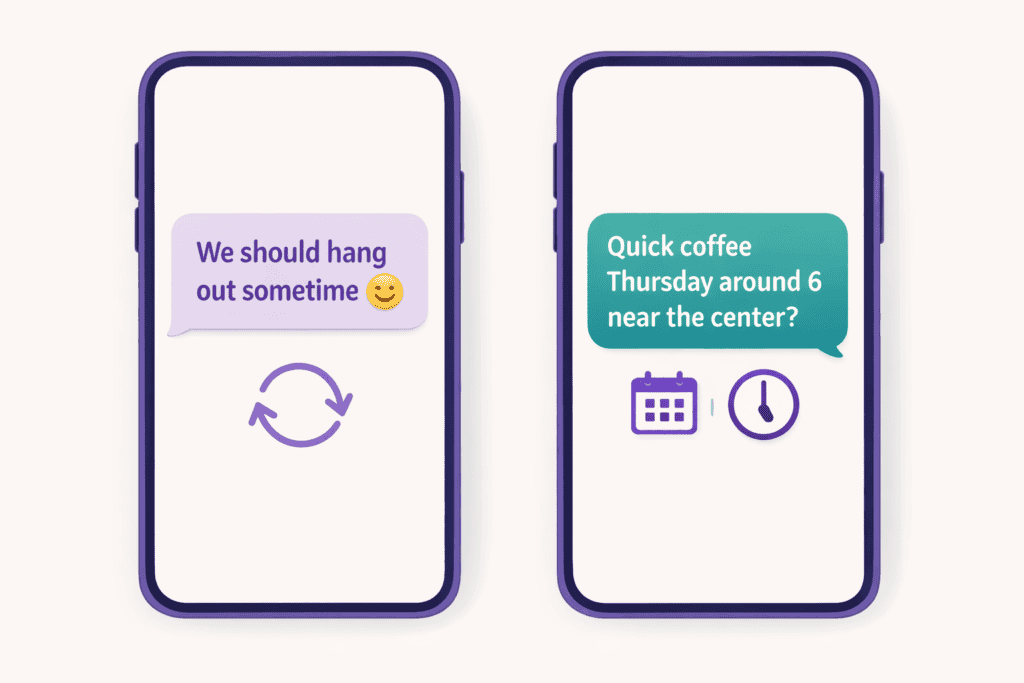
Notice what these do.
They don’t beg.
They don’t demand.
They offer a real option.
If the person is interested, they usually respond with a yes or a counter-offer.
That counter-offer is the key.
Someone who’s serious about meeting will help solve the scheduling problem with you.
And if they’re cautious (which is normal), you can keep it safe while still moving forward.
If they resist meeting, offer one smaller step that keeps safety and reduces pressure, like a short call.
No rush on meeting. Want to do a quick 10-minute call sometime this week?
This matters because the clearest signal is willingness to pick a day and time, not message quality.
You’re looking for coordination, not perfect banter.
What about getting their number first?
It’s optional.
Some people prefer it.
Some don’t.
It can help with logistics, but it doesn’t replace the real test.
The real test is still: do they choose a time?
If you feel nervous asking, keep it even simpler.
Make the invite match the level of connection you actually have.
A low-pressure plan is easier to offer because it doesn’t pretend you already have something big.
What to Stop Doing
Stop trying to “earn” the date by entertaining longer.
That mindset turns chatting into a performance.
You start editing yourself, rereading messages, and treating the next text like a make-or-break moment.
Stop keeping it vague for too long.
“We should hang out sometime” often becomes a loop.
If you want to meet, a small, specific plan is kinder than endless flirting.
Stop escalating stakes when you don’t have clarity yet.
Dinner, long nights out, “let’s do something special,” all raise pressure.
Pressure makes people stall, even when they like you.
Stop chasing soft no’s.
If you hear “I’m busy” and there’s no alternative offered, don’t fill the silence with three more options and a long explanation.
Give it one clean opening for a counter-offer.
No worries. If you want to meet, tell me what day works for you.
Then pause.
Stop negotiating your way into a date.
If it takes five rounds of back-and-forth just to land on a time, that’s information.
You don’t need to punish them for it.
You just don’t need to keep investing like it’s going somewhere.
Stop turning it into a test of their character.
Avoid lines like “If you were serious, you’d meet.”
That usually creates defensiveness and doesn’t get you a clearer answer.
Edge Cases / Limits

Some people move slowly for understandable reasons: safety, bad past experiences, anxiety, a hectic schedule.
A slow pace isn’t automatically a dead end.
But you still need a path forward that doesn’t turn into months of chat.
If someone won’t meet yet, the smaller-step option matters.
A short video call can be a strong middle ground.
It’s also a practical filter for identity uncertainty without making it a big accusation.
If someone won’t meet and won’t do a short call, it’s okay to treat that as your answer and step back.
Not with drama.
Just with a simple fade or a polite close.
Safety stays basic and calm.
Meet in public.
Tell a trusted person where you’re going.
Keep control of your transport so you can leave whenever you want.
These steps make dating safer and also make “yes” easier for the other person, because the plan feels normal and low-risk.
If you’re unsure about scams or pressure tactics, it’s worth reading a our consumer scam-awareness page on romance scams, plus a general safety checklist for meeting someone new.
Most apps also have a Safety Center page with reporting and safety tips you can reference.
There’s also a limit you can’t message your way around: chemistry and intent.
Some people enjoy chatting more than meeting.
Some are bored.
Some are hiding something.
You won’t always know which one it is, and you don’t need to solve it.
Final Takeaway
The goal isn’t to craft the perfect message.
If you want to go from chatting to a first date, use the invitation as a way to make things clear, not as a test. Keep it short, clear, and easy to say yes or no to.
When you move from chat to a specific invite (day, time, place), you get clarity fast.
That’s the upside: you either go on a date, or you stop feeding a chat loop that wasn’t going anywhere.
A clean invite won’t “convert” the wrong person.
It just shows sooner whether meeting is real.
If you keep seeing long, fun chats that never land on a day and time, this approach will help you stop wasting time.
If meeting soon isn’t possible because of distance or scheduling, start with a short call and let the next step earn itself.