Is OkCupid worth it in 2026? For most people, no.
The compatibility system is still unique, the free messaging is still generous, and the 60+ identity options for LGBTQ+ users are unmatched. But the active user base has shrunk in most cities, Match Group has gutted the question depth that made the app special, and paying for Premium won’t fix a thin local pool.
OkCupid is worth a free trial if you’re in a top-10 metro area or need the identity infrastructure. For everyone else, Hinge delivers better results with less effort.
OkCupid used to be the smartest dating app online. Thousands of user-created questions, a visible compatibility percentage, free messaging, deep profiles that actually told you something about a person before you swiped.
It was the one app where answering questions honestly could change who you saw and who saw you.
The bones of what made OkCupid good are still there. The question is whether the bones are enough, or whether you’re paying to use a platform that peaked five years ago and has been coasting since.
How this review works
This review covers what actually happens when you use OkCupid today: how matching works, what paying changes, and whether the compatibility system still delivers results or just generates numbers. For more on our process, see: How We Review Dating Apps (2026): What Actually Matters
Table of Contents
Is OkCupid Worth It?
Is OkCupid worth it? Only for a specific kind of dater.
If you care about compatibility depth, want free messaging without a paywall on conversations, or need a platform with over 60 identity options for gender and orientation, OkCupid still offers things no other major app does.
If you just want to meet people efficiently in 2026, the active user base has thinned out too much in most cities to justify the time.
Best for:
- LGBTQ+ users who need identity options (over 60 and counting) that Hinge, Bumble, and Tinder still don’t fully match
- Compatibility-focused daters in large metro areas where the user pool is still active enough to surface fresh profiles
- Budget-conscious users who want to message matches without paying, something almost no other app allows for free
Not for:
- Anyone in a mid-size or smaller city where the recycled profile problem will hit within the first week
- Straight men dealing with the 65/35 male-to-female ratio, which means more competition for fewer profiles than on Bumble or Hinge
- Anyone expecting the deep-question OkCupid from 2018. Match Group has gutted the question library, and the experience is noticeably thinner
If you want the fastest decision:
- Your city has a strong OkCupid pool → try free for a week
- You see repeats by day 5-7 → leave. Premium won’t fix it
Why Choosing a Dating App Matters
The real cost of picking the wrong dating app isn’t the subscription. It’s the months you spend building a profile, answering questions, adjusting filters, and waiting for matches on a platform where the pool in your area was never deep enough to begin with.
OkCupid makes this worse because it asks you to invest upfront:
- The compatibility questions take real thought
- The profile sections are longer than Tinder’s or Bumble’s
- You’re putting in work before you see a single match
And if your city doesn’t have enough active users, all that effort produces a feed of recycled profiles and likes from accounts that haven’t logged in recently.
The OkCupid free vs paid decision comes down to one question: is your area active enough to justify unlocking what’s behind the paywall?
Match Group’s Q4 2025 earnings (released February 3, 2026) flagged “softness” in the Evergreen & Emerging segment, which includes OkCupid and Plenty of Fish. OkCupid earned roughly $110 million in 2024 revenue, which sounds like a lot until you compare it to Hinge’s $550 million.
The platform is not growing. Choosing to invest your time here means betting on a shrinking pool.
What OkCupid Still Does Better Than the Competition
The compatibility percentage still matters.
No other major dating app has copied this. You answer questions (politics, lifestyle, sex, values), mark how important each one is to you, and OkCupid computes a match percentage with every other user based on overlapping answers.
A 92% match actually means something. You can click into it and see exactly which questions you agreed on and which ones you didn’t.
On Hinge, compatibility is invisible. The algorithm decides what to show you based on behavior, not stated values. On Bumble, there’s no compatibility score at all.
OkCupid is the only app where you can filter by how someone answered a specific question, like whether they want kids, how they feel about drugs, or what their political views are, and make that a hard dealbreaker. If you know exactly what you’re filtering for, this level of control is genuinely useful.
Free messaging is still unusually generous.
OkCupid lets free users send and receive messages once they’ve matched. On Tinder, messaging requires a match but free users can’t send intros. On Bumble, the 24-hour timer pressures conversations. On Hinge, free users get limited likes.
OkCupid’s free tier is the most generous for actual conversations, which matters if you’re not willing to pay for any dating app.
Identity options are still the best on any major app.
OkCupid originally launched with 22 gender identity options and 13 sexual orientations, but has since expanded to over 60 identity options in total, including sub-categories under the asexual umbrella like aceflux, reciprosexual, and demisexual, plus options like hijra and two-spirit that most apps still don’t acknowledge. You can select up to five identities at once.
For non-binary, genderfluid, pansexual, or queer users, this isn’t a feature. It’s the reason to use the app. Hinge and Bumble have expanded their options, but OkCupid still leads.
Where OkCupid Has Gotten Worse
The biggest problem is what Match Group took away.
OkCupid once had over 4,000 user-created questions that shaped your compatibility scores and gave you a genuinely deep way to learn about someone before matching. Match Group has been systematically reducing that library. Long-time users on ConsumerAffairs and Trustpilot consistently describe this as the single biggest quality decline.
The 15-question onboarding quiz still exists, and you can answer more questions manually, but the depth that made OkCupid different has been hollowed out.
What feels worse in 2026 (and why):
- Intro system is one-shot. You send one opening message, and if the other person hasn’t liked you back, your sent message disappears from your own view. You can’t follow up, nudge, or even confirm it was received. If they never circle back, the interaction simply never becomes a conversation
- Free users see one Intro at a time. You have to deal with it (like back or pass) before the next one appears. This is designed to push you toward Premium, where you can see all your Intros at once
- Stacks are microtransactions. Popular and New People cost $1.99 each to unlock for seven days, even if you’re paying for Basic. Only Premium unlocks the Interest Stack
- Aggressive ads. The free tier is full of interruptions, plus OkCupid promotes other Match Group apps (Tinder, Hinge, Match) inside its own interface
- Dynamic pricing. Two users in the same city can see completely different prices for the same plan, based on gender, age, location, and what OkCupid estimates about your willingness to pay. There’s no transparency about how this is determined
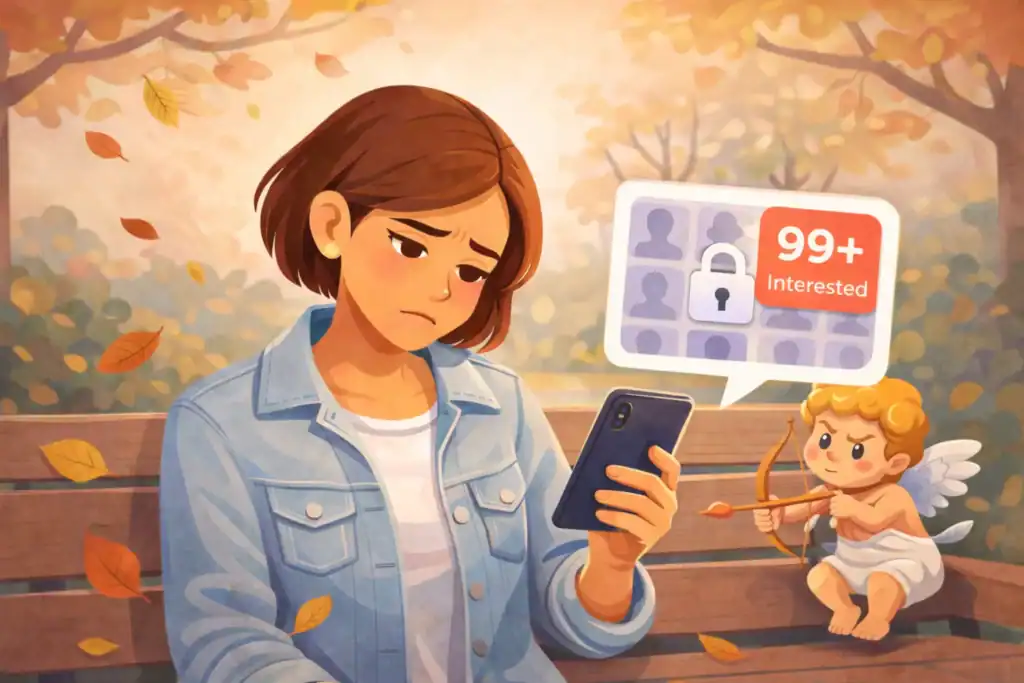
- “Interested in You” inflates the number. The old “Likes You” tab has been renamed and now bundles people who liked you together with people who merely viewed your profile. Since OkCupid’s swipe interface has no skip button, a “viewed you” often means someone who saw your profile and swiped left. The inflated number behind the paywall makes it look like dozens of people are interested when many of them already passed
I’ll be honest: the one-Intro-at-a-time cap is the most cynical design choice on any major dating app right now. It creates the feeling that there’s a pile of interested people waiting behind a wall, and the only way to see them all is to upgrade. Hinge does something similar with its “likes received” blur, but at least Hinge doesn’t make you deal with them one at a time.
OkCupid’s Trustpilot rating sits at 1.2 stars in early 2026. Consumer reviews across Trustpilot, ConsumerAffairs, and the App Store describe the same pattern: fake profiles, matches from accounts that haven’t been active in months, aggressive billing, and a platform that feels abandoned by its developers compared to Hinge and Tinder, where Match Group is clearly investing.
OkCupid for Serious Relationships, Casual Dating, and LGBTQ+ Users
For serious relationships:
OkCupid works when you’re in a large city with enough active users to generate fresh compatibility matches, and when you’re willing to answer enough questions to make the percentage system meaningful.
It fails when your city is mid-size or smaller, because the active pool thins fast and the same profiles recirculate weekly, or when the people you’re matching with haven’t updated their profiles or answered enough questions to produce a reliable score.
For casual dating:
OkCupid is a poor choice. The profile investment is high, the matching is slow, and the active user base skews toward people looking for something longer-term.
If casual is the goal, Tinder has ten times the active user base and costs nothing to message on once matched. Bumble’s expiring matches create urgency that casual daters tend to prefer.
For LGBTQ+ users:
The calculus is different. OkCupid’s 60+ identity options remain the most comprehensive on any major platform. The question-based matching lets queer users filter for shared values in ways that Hinge and Bumble don’t support at the same depth.
If you’re non-binary, polyamorous, or filtering for specific identity-related dealbreakers, OkCupid is still the strongest option. The smaller pool is a real trade-off, but the identity infrastructure matters.
Is OkCupid Premium Worth the Money?
OkCupid’s tier structure has changed. Basic is no longer available for new purchases, per OkCupid’s own help documentation.
If you’re a new user, your options are Free, Premium, or Premium Plus. Existing Basic subscribers can keep their plans, but the cheapest entry point for new paying users is now Premium.
Premium (~$35-$55/mo for 1 month, ~$27-$30/mo for 3 months, ~$20-$25/mo for 6 months):
- See everyone who liked you before you match
- View all Intros at once instead of one at a time
- Read other users’ public question answers before answering yourself
- Three SuperLikes per week
- Access the Interest Stack
If you’re going to pay for OkCupid at all, this is the only tier that makes sense now that Basic is gone.
Premium Plus adds:
- Incognito Mode (invisible to anyone you haven’t liked or messaged)
- No ads
- Priority Likes
- Unlimited read receipts
- 15 weekly SuperLikes
- Monthly Rush Hour Boost token (expires if unused that cycle)
The catch most people miss: the recipient still needs Premium or higher to view their “Likes You” list. If you’re sending Priority Likes to free users, your “priority” placement may not be visible to them at all.
Legacy note: Older versions of Premium used to include automatic daily boosts. OkCupid says legacy members may still have them, but new Premium subscriptions don’t include this. If you delete your account and recreate it, you lose any legacy pricing or features and get slotted into the current membership rules.
Incognito (~$20/mo for 1 month, ~$15/mo for 3 months, ~$10/mo for 6 months) is a standalone privacy add-on if you don’t want the full Premium package.
Pricing reality check:
- All plans are billed upfront
- A 6-month Premium is roughly $120-$150 at checkout, not $22 per month paid monthly
- OkCupid uses dynamic pricing, so the number you see at checkout may differ from what’s listed anywhere online
- There’s no way to predict your exact price without going through the signup flow yourself
The honest assessment: is OkCupid Premium worth it? Only if your problem is not seeing who’s interested in you. Premium solves that. If your problem is that not enough people in your area are using OkCupid, no tier fixes that. And in most mid-size cities in 2026, the second problem is the bigger one.
OkCupid vs the Alternatives You’re Actually Considering
“I want compatibility-based matching but with more active users.”
Hinge is the answer. Hinge’s “Most Compatible” feature is essentially an automated version of what OkCupid used to do manually: it matches based on deeper compatibility patterns, but without requiring you to answer hundreds of questions.
You lose the “why” behind the match (no visible percentage, no shared question breakdown), but you gain a much larger active pool. Hinge has roughly 30 million monthly active users compared to OkCupid’s estimated 10 million, and Hinge’s revenue is growing while OkCupid’s segment is declining.
“I’m a woman tired of being overwhelmed by low-effort messages.”
Bumble’s women-first messaging structure helps more than OkCupid’s open messaging. OkCupid’s 65/35 male-to-female split means women get flooded with Intros, and the one-at-a-time cap on the free tier makes managing that inbox tedious.
“I just want to meet people for free.”
OkCupid’s free messaging is its strongest remaining advantage over Tinder and Bumble. But if you’re in a city where the OkCupid user base is thin, free access to a small pool doesn’t help much. Tinder’s larger free user base may produce more conversations even without OkCupid’s messaging advantage.
“I’m over 35 and want a relationship-focused platform with a larger paying user base.”
Match.com is worth considering. It skews older, the paying user base is larger, and Match Group is still actively investing in it. The trade-off is that Match doesn’t have OkCupid’s compatibility percentage or identity options.
What People Get Wrong About OkCupid
Myth: “It’s still the deep, question-driven OkCupid.” The biggest myth behind “is OkCupid worth it” is that it’s still the platform it was five years ago. It’s not. Match Group has stripped out features, reduced the question library, and shifted development resources to Hinge and Tinder. The compatibility system still exists and still works, but the surrounding experience has degraded. Expecting the 2018 version of OkCupid in 2026 leads to disappointment fast.
Myth: “The free tier is fully functional.” It’s more generous than most apps, yes. But the one-Intro-at-a-time cap, the daily like limit, the constant ad interruptions, and the locked Stacks behind microtransactions ($1.99 per Stack per week) add up to an experience that’s deliberately frustrating. The free tier works. It just works slowly, and that’s by design.
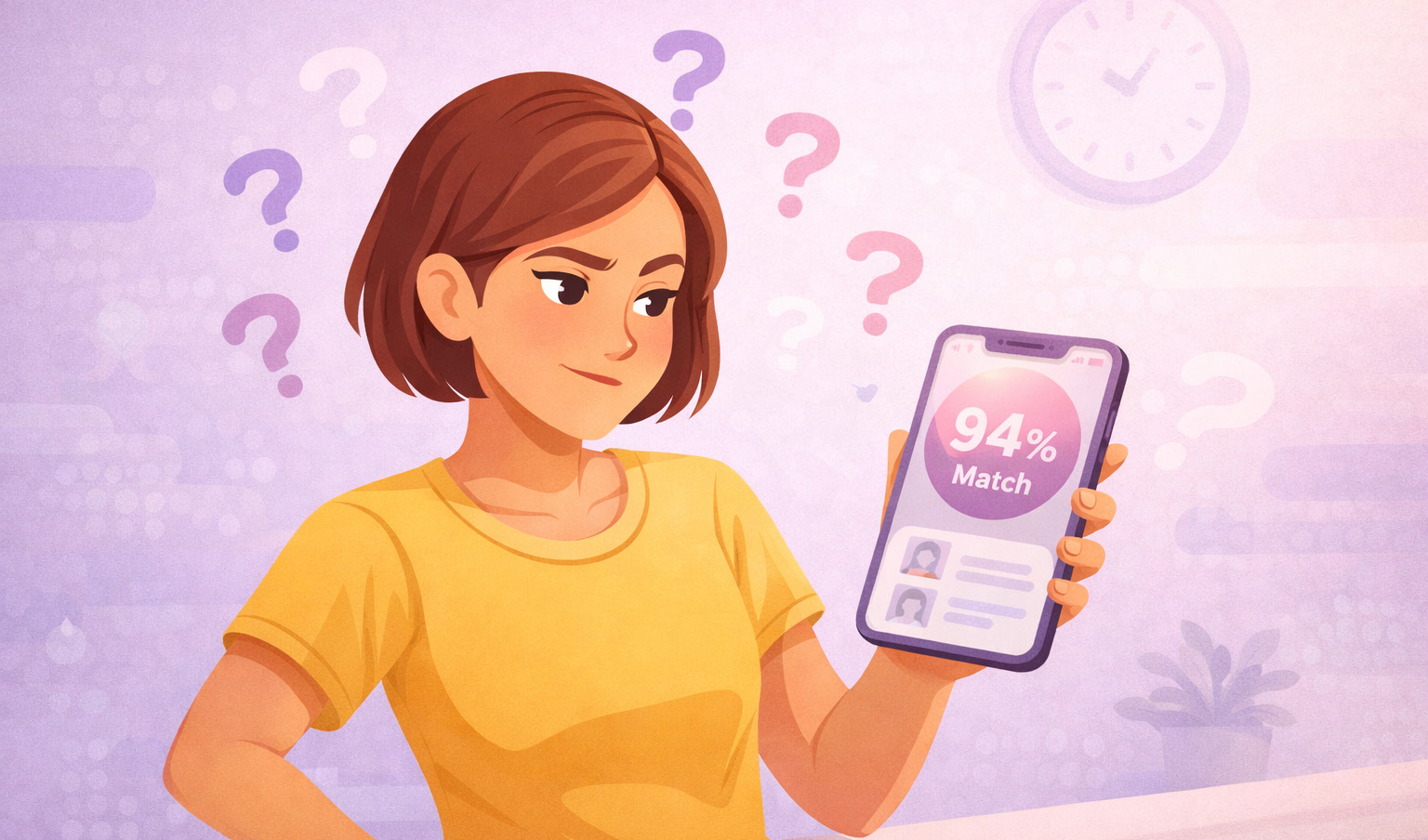
Myth: “More questions guarantees better matches.” It helps, but only if the people in your area have also answered a meaningful number of questions. In cities where the active user base is thin, most profiles have answered the minimum 15 questions, and the compatibility percentage becomes less reliable.
A 94% match based on 15 shared answers is not the same as a 94% match based on 200.
When It’s Time to Leave OkCupid

Your Discover feed is recycling. If you’ve been on OkCupid for six weeks and you’re seeing the same profiles, your city doesn’t have the active user base to support the platform. Switch to Hinge where the pool is bigger and the algorithm doesn’t require you to answer hundreds of questions to work.
Your Intros are going nowhere. If you’re getting Intros but they’re consistently low-effort or from profiles that look inactive, the quality problem is structural, not personal. OkCupid’s declining user base means the ratio of active to dormant profiles is worse than on Hinge or Bumble. Paying for Premium won’t change who’s actually logging in.
You’re stacking purchases and still not meeting anyone. If you find yourself buying Stacks, Boosts, and SuperBoosts on top of a Premium subscription and still not getting dates, you’re past diminishing returns. At that point OkCupid is monetizing your hope, not improving your results.
The app doesn’t feel like what you signed up for. If you originally chose OkCupid for the question depth and you’re finding the current experience thin compared to what it used to be, trust that instinct. The platform you signed up for is not the platform you’re using now.
The Bottom Line on OkCupid in 2026
Is OkCupid worth it in 2026? For most people, no.
The compatibility system is still unique, the free messaging is still generous, and the LGBTQ+ identity options are still unmatched. But the active user base has shrunk, the question depth has been gutted, and Match Group’s own earnings confirm that the platform is not where they’re investing.
In most cities, Hinge delivers better results with less effort.
If you’re LGBTQ+ and need the identity infrastructure, or you’re in a top-10 metro area and genuinely value compatibility-driven matching over speed, OkCupid is still worth a free trial.
But paying for Premium only makes sense if the free tier shows you an active enough pool to justify it:
- Test free first
- If profiles are fresh and matches respond → upgrade
- If the same faces keep showing up after a week → your answer is already clear