

Catfishing in 2026 isn’t just fake photos. It’s filtered images, recycled videos, AI-assisted chats, and outsourced messaging. Text and photos are no longer reliable signals. They’re easy to curate, automate, and fake at scale. Video calls are the fastest way to reduce risk before emotional or time investment, because they introduce real-time presence into a system built to delay it.
Why This Happens
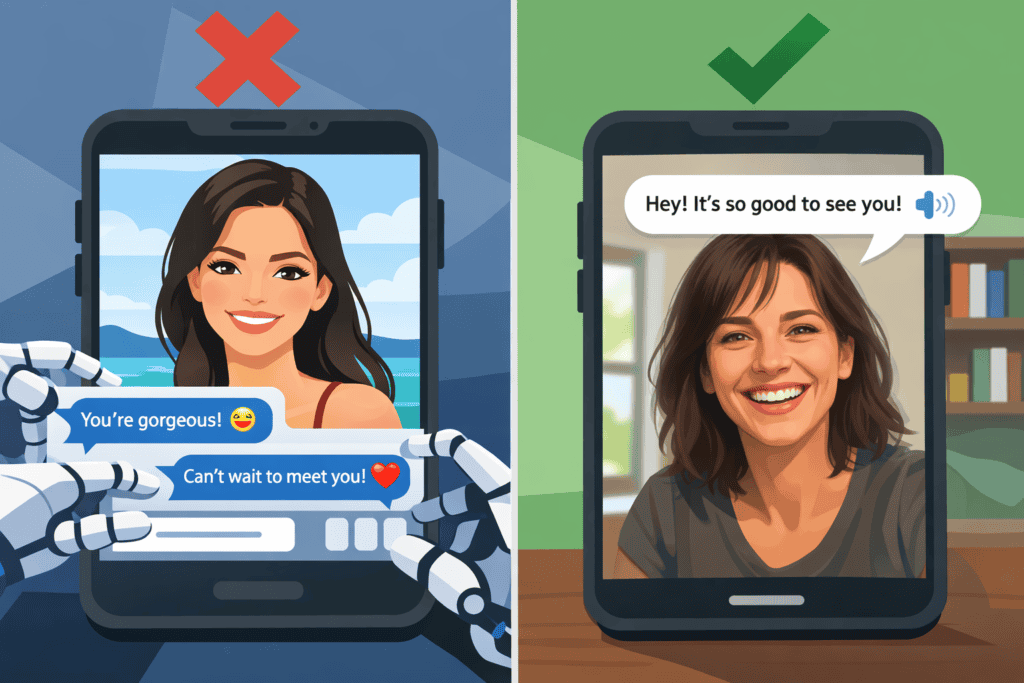
Catfishing persists because most dating-app signals give people too much control. Photos are static. Text lets someone think, edit, stall, or dodge questions entirely. They can ask friends what to say, use AI to sound charming, or disappear for hours and come back with a polished response. Inconsistencies get smoothed over instead of exposed.
Verification systems add a layer of safety—but not enough. Most verification only confirms that a photo once matched a person. It doesn’t confirm who’s currently controlling the account, how honest they are, or whether their intentions line up with what they present. Dating apps also optimize for engagement and retention, not truth, so long stretches of messaging are rewarded while early verification is not.
That’s where video calls change the dynamic. They move interaction from controlled to spontaneous. From curated to real.
What Actually Works
A short video call changes the cost of deception. It forces someone to show up in real time. Fake photos, outsourced messaging, and AI-assisted personas all struggle when voice, timing, and spontaneous reaction have to happen at once. That’s why short, low-pressure calls outperform long ones. They lower resistance and make elaborate excuses harder to maintain.
You’re not trying to prove identity beyond doubt. You’re looking for basic alignment. Does their voice match the energy of their texts? Do they answer naturally, or sound rehearsed? Do they respond fluidly, or does everything feel delayed and over-controlled?
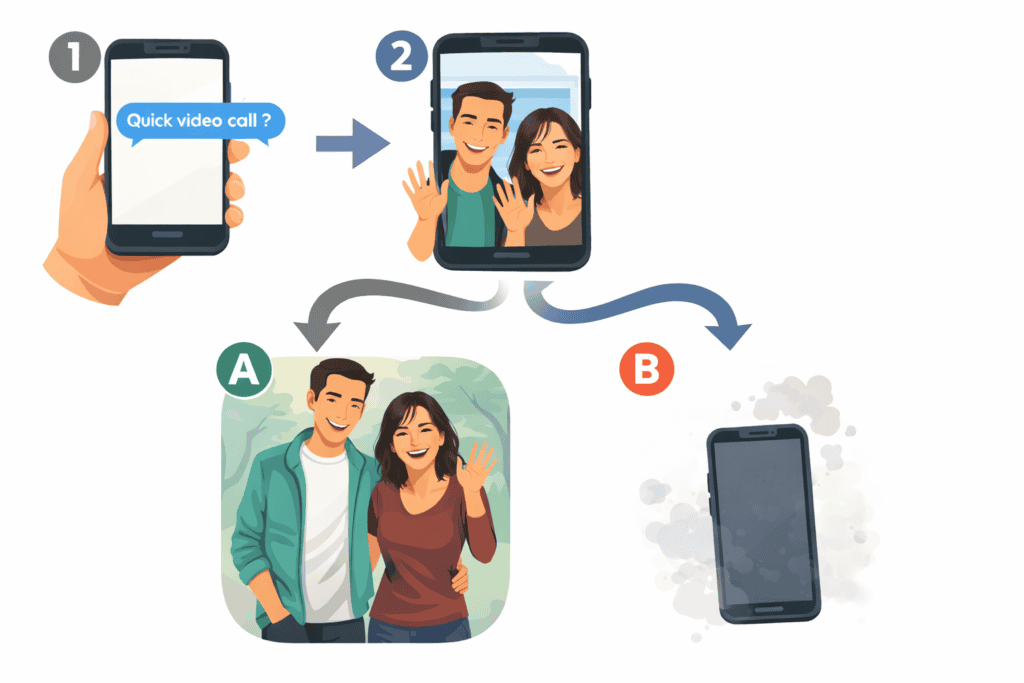
Most people keep it simple when they suggest a call. They frame it as convenience, not suspicion. Something casual works best: “Hey, I’ve been enjoying our chats. Want to do a quick video call? Just five minutes to put a face to the name.” Normal users don’t overthink a request like that.
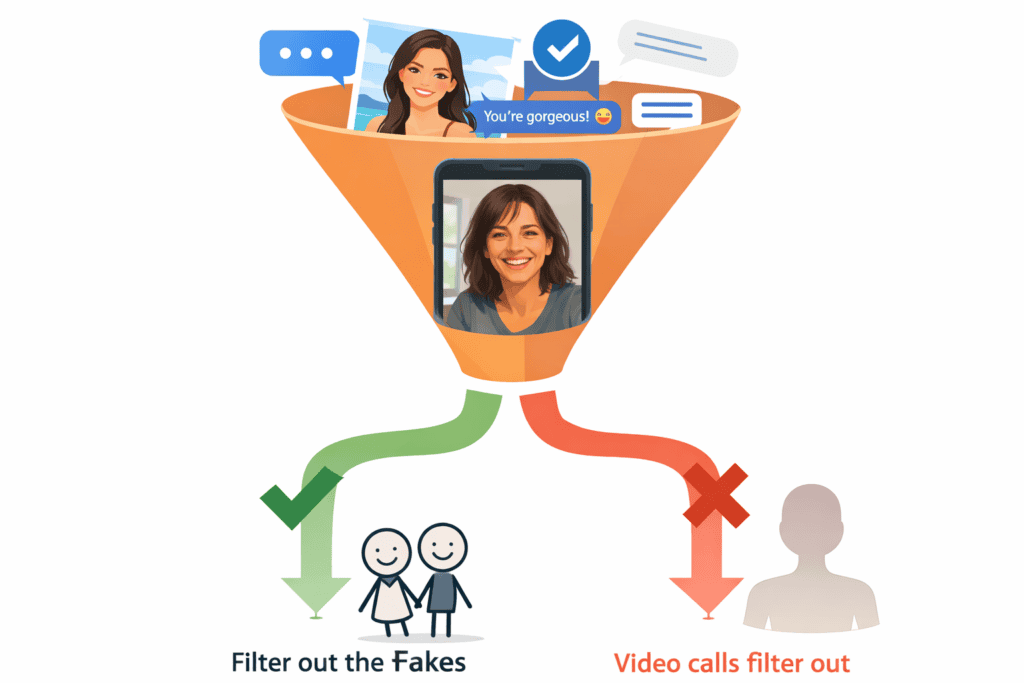
In practice, it often looks like this: great chemistry over text, fast replies, long conversations. But every time a video call comes up, there’s a reason to wait. When the call becomes non-negotiable, the conversation suddenly ends. That outcome is information.
This isn’t proof—it’s a filter. And it’s a fast one. A two-minute video call gives you more signal than a week of messaging. That’s the leverage. Video calls save time and reduce exposure by forcing real-time alignment early.
What to Stop Doing
Don’t assume a verified badge means someone is safe or honest. It usually means they matched a selfie once. That’s not the same as proving who they are now or what they want.
Don’t ignore stalling. Excuses like “my camera’s broken” or “I’m shy” can be reasonable once. Repeated deflection—especially when paired with pressure, emotional escalation, or requests to move off-platform—is a warning sign.
Don’t overshare during an early video call. Treat it as a quick reality check, not a confessional. You don’t need to share your address, workplace, legal name, or personal history. Keep it short, light, and low-stakes.
And don’t fall for the idea that video equals total safety. Deepfakes and AI voice tools exist, but they’re rare and usually obvious. Poor lighting, rigid camera angles, refusal to speak naturally, or constant technical excuses are far more common red flags than advanced technology.
Edge Cases / Limits
Yes, some people can fake a short video call, especially if they’re aiming for delay rather than immediate payoff. But that takes more effort, and most catfish rely on volume, not sophistication. The moment friction increases, they tend to disappear.
Some honest users may genuinely feel uncomfortable on camera. That’s valid. But boundaries still matter. If someone won’t do even a brief, low-pressure call after reasonable rapport, that reluctance is a choice. And it should factor into yours.
Who This Is For / Not For
This approach works best if you’ve dealt with fake profiles, ghosting, or wasted weeks of messaging and want earlier clarity. It’s especially useful for long-distance matches or situations where meeting in person isn’t immediate.
It’s less relevant if you only chat casually, meet same-day, or don’t mind the risk of investing time without verification. The goal isn’t universal adoption. It’s decision clarity.
Final Takeaway
Video calls won’t prevent catfishing completely—but they surface misalignment faster. You’re not trying to verify someone’s entire story. You’re trying to answer one question early: does this person show up when it matters?
If someone can’t show up on camera for five minutes, they’re unlikely to show up consistently in real life either. Better to find that out now than weeks down the line.