
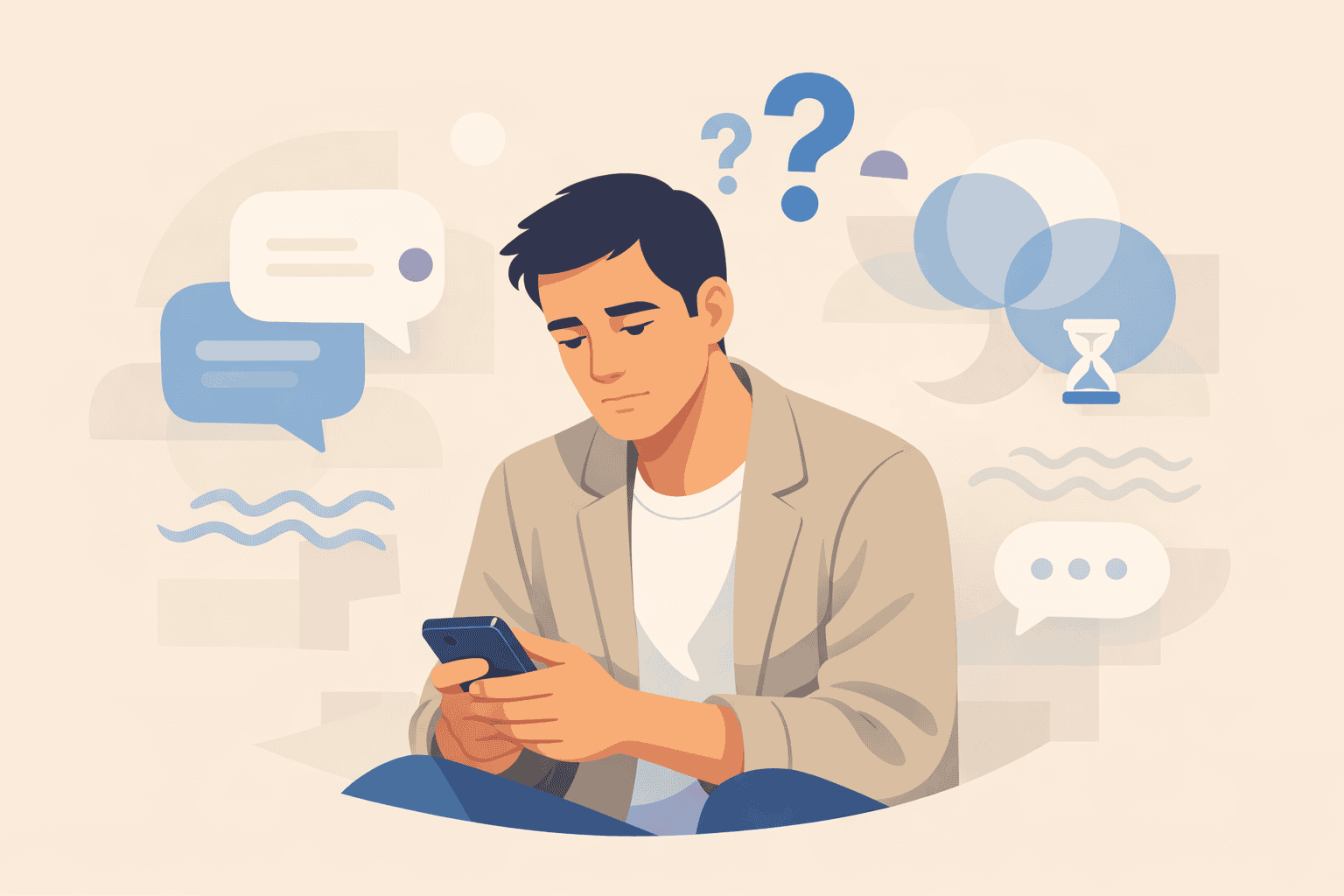
You can spend 20 minutes on a dating app and feel tired like you just socialized for two hours.If you’ve ever thought “maybe a dating app for introverts would feel easier,” this is why it often doesn’t. For introverts this is often why online dating is draining: nothing “bad” even happened. No argument. No rejection. Sometimes you didn’t even talk to anyone. And still: drained.
That’s the part that messes with your head. Because it doesn’t look like effort, but it feels like effort.
Why am I exhausted… I didn’t even do anything?
Most people read that tired feeling as a personal problem. Maybe I’m too sensitive. Maybe I’m boring. Maybe I’m not built for this. Maybe I’m doing it wrong because other people make it look easy.
For a different outlook check my : Why Dating App Conversations Die tips
It turns into a quiet shame spiral: if it costs me this much energy to talk to strangers, how am I supposed to date at all?

It’s not the talking. It’s the constant decoding.
The “Open Tab” Syndrome.
It’s always sitting there in the background. A chat can restart at any time, so your brain keeps it open like a browser tab you never fully close. Even when you’re not actively messaging, part of your CPU is dedicated to tracking it. This is attention without closure, and it’s why 20 minutes of swiping feels like two hours of socializing.
Online dating is a low-signal environment. You get a photo and a sentence; your brain tries to build a whole human out of it. That “guessing work” is expensive. If the inputs are vague, the drain isn’t your “introvert wiring” it’s your brain trying to solve a puzzle that’s missing half the pieces.
That’s not enough to feel grounded, so you fill in the gaps.
- Tone
- Intent
- Vibe
- Are they interested? Are they joking? Did I say something weird? That guessing work is expensive, especially if you tend to think before you speak.
Then there’s the quiet decision fatigue. Lots of profiles that feel almost the same. Lots of “maybe” options. Lots of tiny judgments that don’t feel like judgments. You make them anyway. Over and over.
Messaging adds another layer because it isn’t real-time. The pauses create uncertainty, and uncertainty invites re-reading. You start running little simulations: what they meant, what you meant, what your message sounded like on their screen.
Every so often, the app gives you a small moment of clarity. A match. A good reply. A stretch where it feels easy. Then it goes quiet again. That on-and-off pattern keeps a thin thread of attention attached, even when you’re trying to move on.
If the people you’re interacting with are vague, inconsistent, or low-effort, the drain may be less “introvert wiring” and more “the inputs aren’t worth the processing.”
The part where you try harder… and it gets heavier
When something feels unclear, the instinct is to add effort. You think: I’ll be more interesting. I’ll reply faster. I’ll think this through more carefully.
But on dating apps, more effort often just means more interpretation and more performance. You’re spending extra energy trying to create certainty in a place that can’t really give it to you yet.
That’s where introverts tend to get stuck. You keep investing energy to earn clarity, and then you blame yourself when the clarity never arrives. The drain compounds, not because you’re doing something wrong, but because the system keeps asking you to do more mental work without resolving anything.
Seeing this clearly changes the story you tell yourself. Less self-blame. Cleaner expectations. Fewer false conclusions about who you are.

When this clicks immediately
- If you keep feeling strangely tired after a few polite back-and-forths, read that fatigue as “I’m doing a lot of decoding,” not “I’m failing at dating.”
- If you tend to workshop your tone until it feels perfect, remember that apps are low-signal places. They don’t give enough signal to support high-confidence conclusions about you.
- If you feel most drained when things stay vague, recognize that uncertainty itself is doing the tiring.
A cleaner way to read the whole experience
When it feels heavy this fast, it’s usually not because you’re bad at dating. It’s because you’re doing a lot of mental work for very little signal. Seen that way, the tired feeling stops being a verdict and starts being something you can learn from.
Introversion isn’t the problem here. The mismatch is.
Dating apps create a lot of social exposure without much grounding, so you end up processing more than you’re receiving. That’s why it can feel like work even when nothing “goes wrong.”
When you notice the drain, you don’t have to treat it as proof that you’re not cut out for this. You can treat it as information about the environment you’re in—and be a lot less hard on yourself because of it.